Why I Switched to All-Fifths Tuning (and Left Fripp's Compromise Behind)
A month ago I retuned a guitar in perfect fifths and never switched it back. Here is why, and why the one famous workaround was never really necessary.
Over the past month I retuned one of my 28" scale-length baritone guitars to all fifths, every string a perfect fifth above the one below it, and I have not put it back. It quietly rewired how I see the fretboard, and most of what I thought I knew about "weird" tunings turned out to be a habit, not a rule.
One shape, every key, in two directions
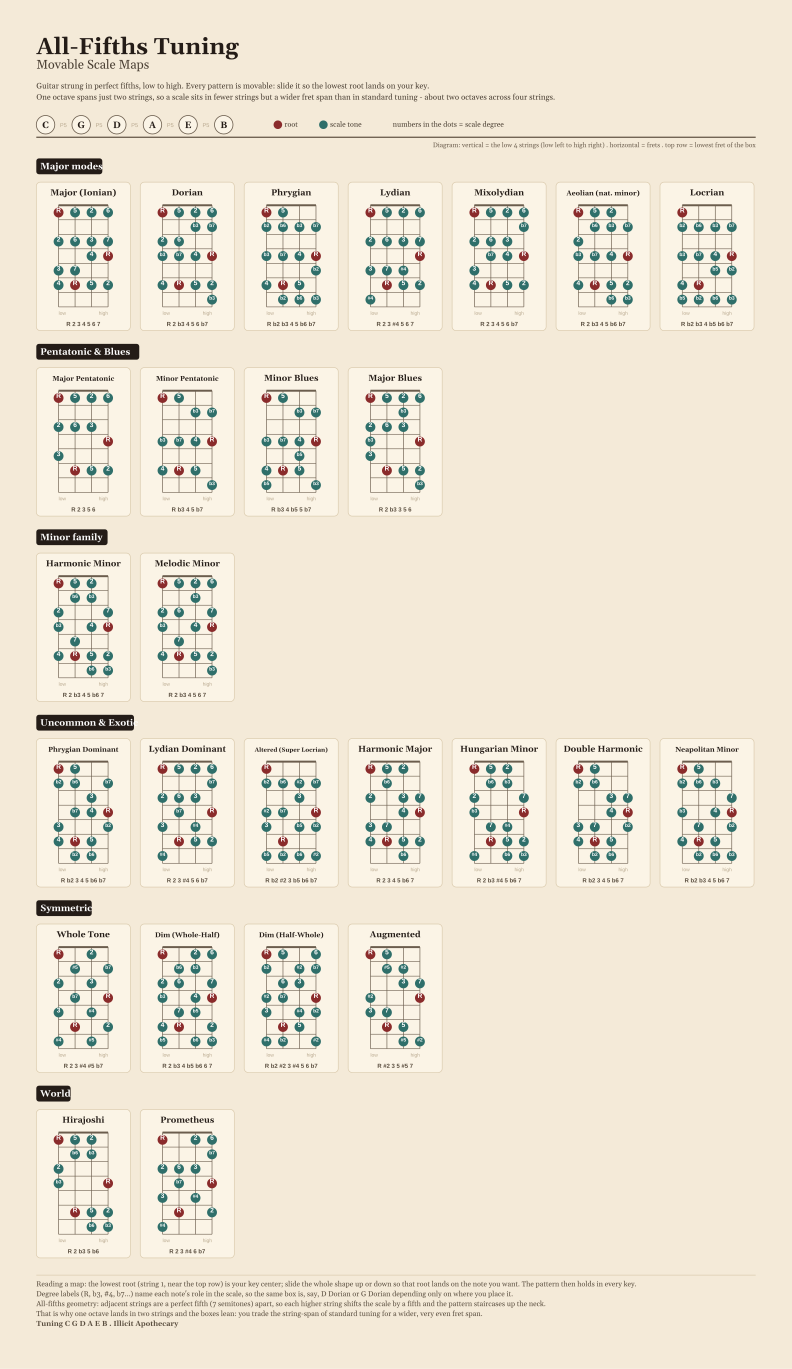
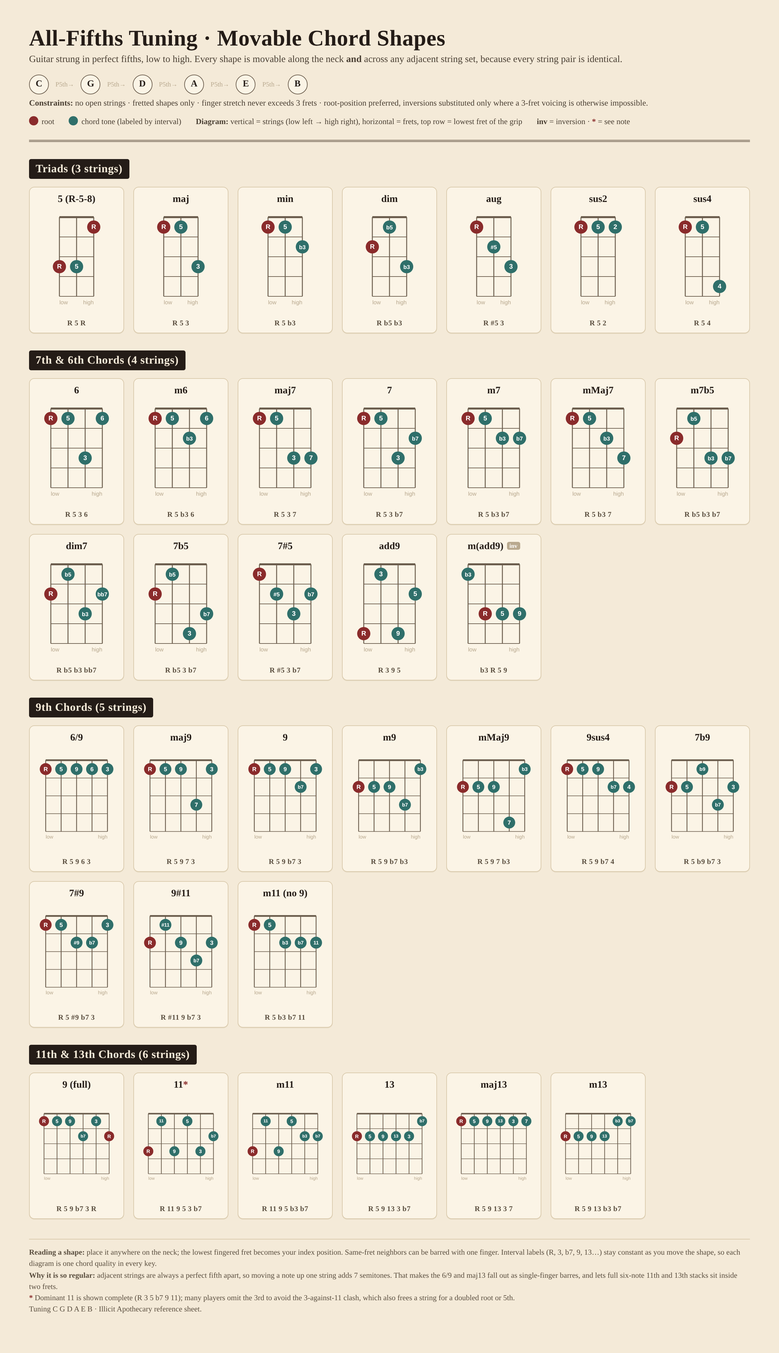
Because every pair of strings is the same interval, a chord shape is movable two ways at once: up and down the neck like a barre chord, and sideways across string sets. Learn a voicing once and you own it in all twelve keys and on every string group. The range is huge, a low C that sits below standard tuning's low E and a top that climbs past where standard runs out. This is the tuning of the cello, viola, mandolin and tenor banjo, so the wide four-note-per-string scales come built in. If you have ever envied how logical a violinist's fingerboard looks, this is that logic on a guitar. The textbook spelling is C G D A E B low to high; move the whole stack up or down and every shape stays exactly the same, which matters in a minute.
The famous workaround, and the problem behind it
If you have heard of fifths on a guitar at all, you have probably heard of Robert Fripp's New Standard Tuning. NST is C-G-D-A-E-G. Look hard at that top string: it is a G, not a B. Five of the six strings climb in clean perfect fifths, and then the last one stops short at a minor third. Fripp's original vision was true all fifths. In his own words, "the top string would not go to B." A high B on a normal guitar scale sits so close to the snapping point of plain steel that in the 1980s his strings kept breaking. He tried an A on top. Those broke too. He settled on G, and NST was the result.
The compromise you no longer have to make
Here is the part that changed how I think about it: that was a 1983 string problem, not a law of physics. There are two clean ways around it, and I have been living in both this month.
- The right strings. Ultra-thin plain steel exists now that did not exist when Fripp was breaking high B's. Gary Goodman's Octave4Plus sets go all the way down to a .007, thin enough to actually hold the true high B that NST gives up on.
- The right pitch. You do not even need that high B. Anchor the whole stack a fifth lower and the top string only has to reach E: F-C-G-D-A-E. Every interval is still a perfect fifth, the shapes are identical, and the top string now lives in comfortable, unbreakable territory. Same all-fifths payoff, none of the apology. This is the tuning I settled on, and the exact set is below.
The route I took: fifths on a baritone
If you want the range and the robustness without babying a hair-thin top string, put fifths on a baritone guitar, which is exactly what I did. The longer 28-inch scale is built to hold lower tunings at healthy tension, so a fifths set sits right where it wants to be. I had Stringjoy build me a custom nickel-wound set for it, tuned F-C-G-D-A-E low to high: a clean perfect-fifth stack anchored a fifth below the textbook C version, so the top string only has to reach a normal high E.
| String | Note | Gauge | Tension |
|---|---|---|---|
| 6 (low) | F1 | .085w | 20.7 lb |
| 5 | C2 | .056w | 20.9 lb |
| 4 | G2 | .036w | 19.4 lb |
| 3 | D3 | .020p | 17.1 lb |
| 2 | A3 | .0135 | 17.5 lb |
| 1 (high) | E4 | .009 | 17.4 lb |
That table is the whole trick. The top string is an ordinary plain .009 at E4, the same pitch as a standard guitar's high E, pulling a comfortable 17 pounds. No .007, no snapping high B, no compromise anywhere in the set. It is tension-balanced on purpose, roughly 17 to 21 pounds across all six strings and about 113 pounds total, so nothing feels floppy on the bottom or piano-wire tight up top. I planned it on Stringjoy's string tension calculator before ordering, which is the tool I would point anyone to before committing to a nonstandard tuning. As a builder, that is the honest answer to me: pick the right instrument and the right strings, and you get real all-fifths with nothing to work around.
Who else is down here
True all-fifths has always been a small, stubborn club, and it is worth knowing the company.
- Carl Kress tuned his jazz guitar in fifths back in the old rhythm-guitar days, long before it had a name.
- Robert Fripp of King Crimson built a whole teaching tradition, Guitar Craft, around his near-fifths NST, which is how most players first meet the idea.
- The deepest roots are on the low end. Red Mitchell, the great jazz double bassist, retuned to fifths in 1966 and never looked back. Joel Quarrington carried it into the orchestra and is probably its leading living champion. Bassists have quietly known for decades what guitarists are only now circling back to.
A month in
I am sold. The poster up top is the cheat sheet I built for myself while learning the tuning: every shape from a three-string triad to a six-string 13th, all movable, no open strings, nothing that asks for more than a three-fret stretch. If you have a spare guitar and a set of the right strings, retune it tonight. Worst case, you get to learn the fretboard twice, and the second time it finally makes sense.
New Standard Tuning and All fifths tuning (Wikipedia), including Fripp's account of the top string and the Octave4Plus .007 gauge by Gary Goodman. | Red Mitchell's 1966 switch to fifths and Joel Quarrington's advocacy: joelquarrington.com. | Carl Kress fifths tuning: All fifths tuning (Wikipedia). | Strings and tension planning: Stringjoy and their String Tension Calculator.